Practical Quantum Advantage for Distributed Systems Coordination

The full paper is available at: https://arxiv.org/abs/2604.07451
Introduction
As quantum technologies advance rapidly, a central question is shifting from whether quantum advantage exists to where it can be realized with near-term hardware. While much attention has focused on quantum computing, its most prominent applications, such as factoring large numbers used in modern cryptography or simulating complex quantum materials, typically require large-scale fault tolerance and remain beyond the reach of current devices.
In contrast, a different route to quantum advantage has emerged within the broader vision of the quantum internet [2]. Rather than relying on computational complexity, it exploits quantum correlations enabled by shared entanglement. In this setting, even noisy entanglement can provide a measurable advantage in tasks where classical coordination is fundamentally limited [3–5].
Recent studies [3], as highlighted by The Quantum Insider [6], have shown that remote entanglement allows correlations that surpass classical bounds, enabling improved coordination without communication in time-critical distributed tasks. These include settings where decisions must be made faster than any signal can propagate, such as high-frequency trading, power grid control, and network load balancing.
A key challenge is whether this advantage can be made statistically certifiable under realistic conditions. In practice, the advantage must be demonstrated within a finite time window over which the underlying correlations remain stable. This requires generating entangled pairs fast enough to accumulate sufficient statistical evidence before the environment changes, placing a direct constraint on the required operation rate.
In our work [1], we address this gap by establishing concrete operational criteria for quantum-enhanced distributed coordination. By linking entanglement fidelity, generation rate, and decision latency to statistically certifiable performance, we provide a quantitative framework for implementation. As a representative example, we show that a cavity-assisted neutral-atom quantum network architecture can meet these requirements in regimes relevant to inter-venue high-frequency trading, providing a viable pathway toward practical quantum advantage with near-term hardware.
Real-World Distributed Coordination Under Latency Constraints
Modern infrastructure, from financial markets to power grids and data centers, relies on distributed systems in which decisions are made locally across geographically separated nodes. In certain regimes, these decisions must be taken on timescales shorter than the communication latency between nodes, effectively prohibiting any real-time coordination.
This regime is known as latency-constrained tacit coordination (LCTC). A canonical example is high-frequency trading: trading venues separated by tens of kilometers must react within microseconds, while communication between them takes orders of magnitude longer. As a result, decisions must be made locally based on pre-shared strategies, without any exchange of information during execution.
Similar constraints arise in power grid control and network load balancing. Distributed controllers must respond to local signals, such as faults or congestion, before system-wide information becomes available. The objective is to coordinate actions across nodes despite the absence of communication, balancing consistency and diversification depending on the global state.
These settings define a fundamental limitation of classical systems: coordination must rely entirely on shared randomness and pre-agreed rules. This naturally leads to a formulation in terms of nonlocal games, where the role of shared randomness can be replaced by shared entanglement.
Nonlocal Games: Classical vs. Quantum
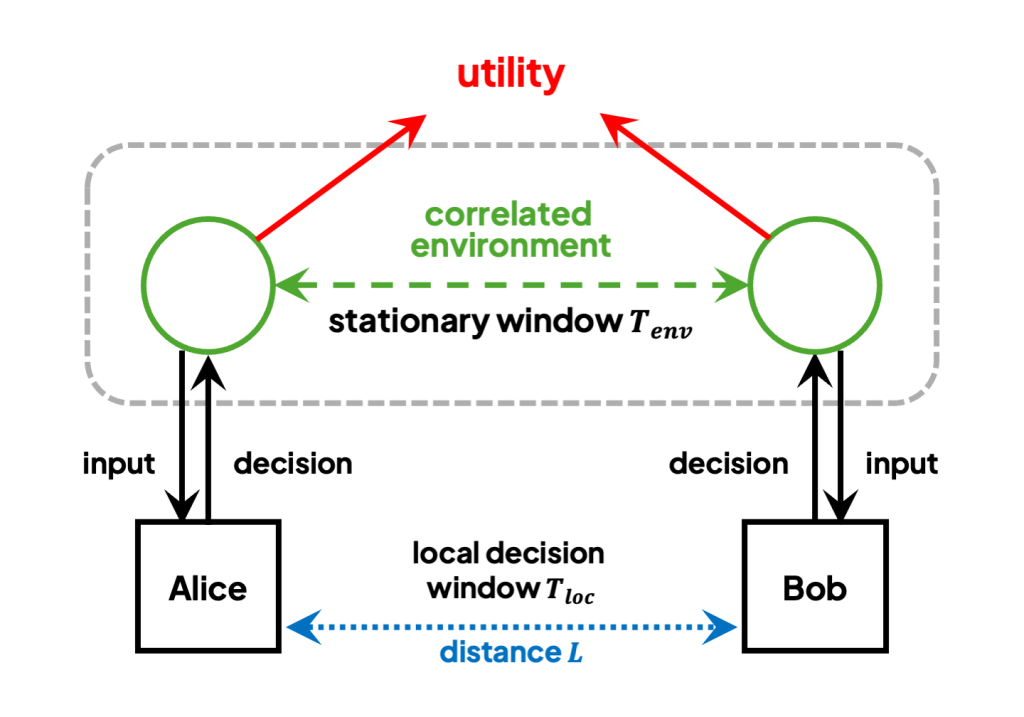
In a nonlocal game, spatially separated parties, Alice and Bob, receive local inputs and must produce outputs without any communication, as illustrated in Fig.1. Their performance is evaluated by a scoring rule that assigns a value to each combination of inputs and outputs, rewarding coordinated actions and penalizing mismatches. The goal is to make decisions that lead to the highest average score over many repetitions.
- Classical strategy: The players are limited to local strategies supplemented by shared randomness. Each party’s action depends only on its own input and pre-agreed correlations, which sets a strict upper limit on how well they can coordinate.
- Quantum advantage: The players may instead share an entangled state before the game begins. By performing local measurements, they access correlations enabled by entanglement that cannot be reproduced by any classical strategy. These nonclassical correlations, captured by Bell inequalities, allow them to achieve a higher average score than any classical strategy.
A canonical example is the Clauser-Horne-Shimony-Holt (CHSH) game, which provides a standard benchmark for such quantum advantage. In our work, we build on this foundation by considering generalized XOR games, where the scoring rule depends only on the parity of the outputs but allows for asymmetric costs and realistic input correlations. This extension makes it possible to model practical coordination tasks while retaining the same fundamental source of quantum advantage.
Our Solution: Operational Quantum-Enhanced LCTC
A crucial question is whether this form of quantum advantage can be made statistically certifiable under realistic conditions. In practice, coordination must be achieved within a finite time window, with limited decision rates and imperfect operations. Once these constraints are taken into account, the requirements for demonstrating quantum advantage become significantly more stringent than suggested by idealized models.
Building on the LCTC framework introduced in [3], our work establishes a concrete, end-to-end approach to this problem. We extend the formulation to incorporate realistic features such as finite operational rounds, asymmetric costs and payoffs, and imperfect quantum operations, and map these directly onto hardware requirements.
Within this framework, we identify three operational criteria that must be simultaneously satisfied to achieve statistically robust quantum advantage:
- Fidelity criterion
The combined error from entanglement generation and measurement must remain below a threshold set by the intrinsic quantum advantage. - Rate criterion
Because the environment remains stable only over a finite time window, the system must generate entangled pairs fast enough to accumulate sufficient statistical evidence within this period. This sets a direct requirement on the entanglement generation rate. - Decision criterion
Each decision must be completed within a strict latency window, placing an upper bound on the time for local operations, including measurement, qubit control, and classical processing.
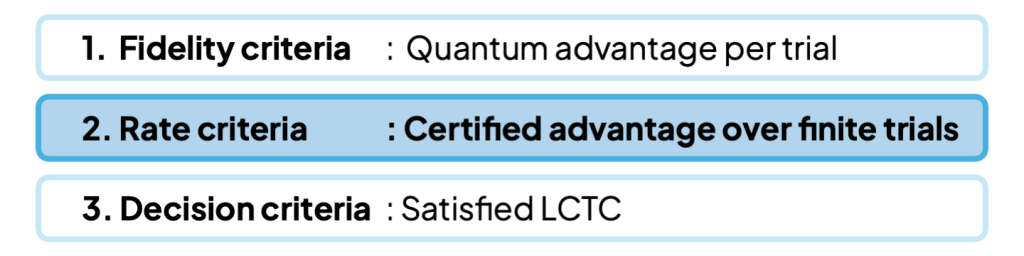
These criteria provide a direct bridge from abstract quantum advantage to physical implementation.
Hardware Requirements and Implementation
These operational criteria translate into a small set of core hardware capabilities: high-fidelity and high-rate remote entanglement generation, entanglement storage, and fast local measurement and reset. These primitives enable the preparation, buffering, and consumption of entangled resources for decision making when required.
Achieving the required performance is primarily a question of throughput. Remote entanglement generation is probabilistic and limited by communication latency, so sequential operation leads to low effective rates. To reach the required rate, the system must operate in a time-multiplexed manner across many memory qubits, allowing entanglement attempts to proceed in parallel while successful states are stored and reused. In this way, latency is absorbed into the architecture, enabling a high effective rate of usable entanglement.
Neutral atoms coupled to optical cavities are particularly well suited for this setting, especially with ytterbium. They enable telecom-band photon generation for low-loss remote entanglement, while a second optical transition in the visible range supports fast, high-fidelity readout through a two-color cavity. At the same time, nuclear spin states provide long coherence times for storing entangled states. Combined with the ability to host many atoms within a single system, this platform naturally supports large-scale multiplexing while maintaining fast local operation.
Implementation with Yb atoms coupled to the two-color cavity
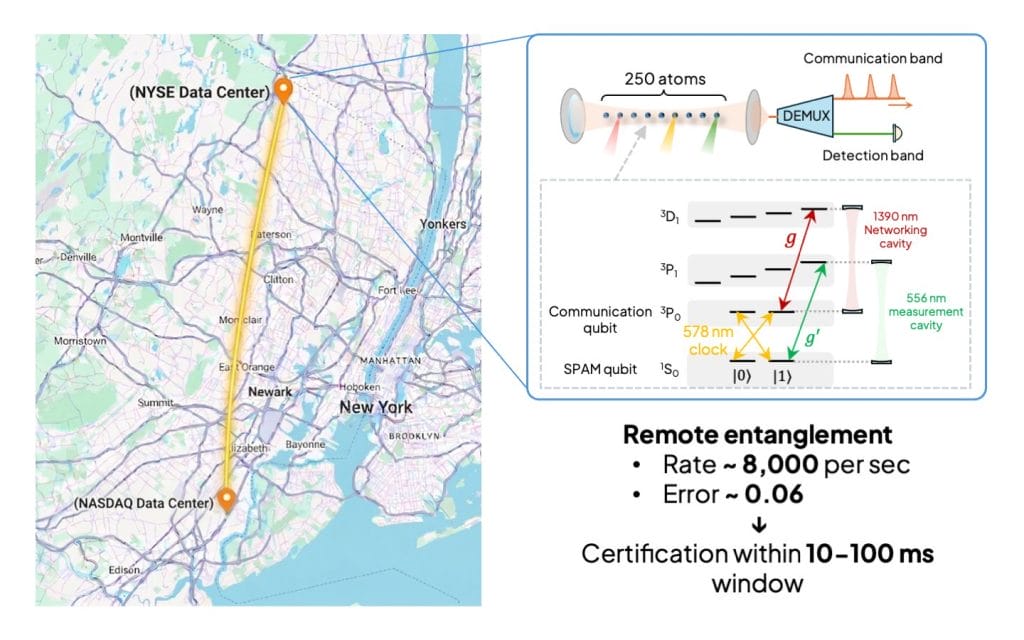
To make these requirements concrete, we evaluate system-level performance for a representative high-frequency trading task over a 50 km fiber link, comparable to the NYSE–NASDAQ separation, as shown in Fig.3. The two-color cavity enables fast state readout at the microsecond scale using a visible transition. This local decision timescale is well below the communication latency of about 200 microseconds set by the distance between nodes, thereby satisfying the decision criterion.
Incorporating realistic optical losses, fiber attenuation, and detector dark counts, we estimate a combined operational infidelity below 6%, satisfying the fidelity criterion across relevant coordination scenarios. With a memory capacity of approximately 250 atoms per node, time-multiplexed operation absorbs the link latency and avoids channel bottlenecks, enabling a heralded entanglement generation rate of about 8 kHz per channel using a two-photon interference protocol [7]. This rate exceeds the threshold required to achieve statistically certifiable quantum advantage within typical environmental stability windows of 10 to 100 milliseconds. These results indicate that nanofiber cavity–based quantum network nodes have the potential to meet the operational requirements for practical LCTC applications.
Outlook
Quantum advantage in nonlocal games arises from entanglement, but its practical realization depends on whether it can be statistically certified under realistic constraints. We address this by establishing operational criteria that link quantum advantage to finite time, finite rate, and imperfect operations, showing that the requirements are stringent but achievable. We find that a cavity-assisted neutral-atom platform can meet these criteria in regimes relevant to applications such as inter-venue high-frequency trading, providing a near-term pathway to demonstration. More broadly, this work represents a first step toward a distinct class of quantum applications based on quantum correlations rather than computational complexity, with many promising real-world opportunities yet to be explored.
References
[1] C Li, S. Kikura, A. Goban. H. Yamasaki, S. Sunami, “Operational criteria for quantum advantage in latency-constrained nonlocal games”, arXiv:2604.07451.
[2] S. Wehner, D. Elkouss, R. Hanson, “Quantum internet: A vision for the road ahead”, Science 362, 6412, 2018.
[3] D. Ding and L. Jiang, “Coordinating decisions via quantum telepathy”, arXiv:2407.21723.
[4] F. F. da Silva and S. Wehner, “Entanglement improves coordination in distributed systems”, in Proceedings of the 2nd Workshop on Quantum Networks and Distributed Quantum Computing, SIGCOMM ’25 (ACM, 2025) p. 14–20.
[5] V. Arun, V. Chidambaram, and S. Aaronson, “Faster than light coordination for networked systems with quantum non-local games”, Proceedings of the 24th ACM Workshop on Hot Topics in Networks, HotNets’25 (ACM, 2025) p. 10–18.
[7] S. Kikura, R. Inoue, H.Yamasaki, A.Goban, S. Sunami, “Taming the Recoil Effect in Cavity-Assisted Quantum Interconnects”, PRX Quantum 6, 040351 (2025). (Blog Page)
[8] S. Kikura, K. Tanji, A. Goban, S. Sunami, “Passive quantum interconnects: multiplexed remote entanglement generation with cavity-assisted photon scattering”, arxiv:2507.01229. (Blog Page)