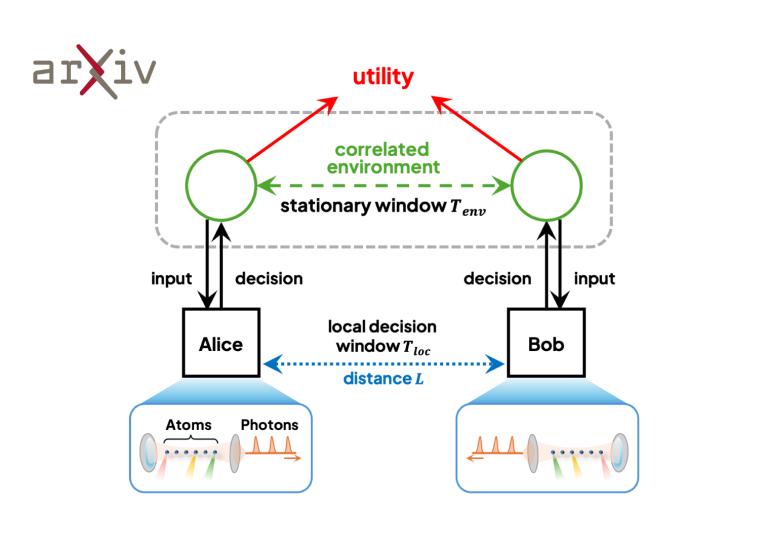
Passive Quantum Interconnects Are Intrinsically Robust to Motion-Induced Errors

The full paper is available at: arXiv:2606.26542 [1]
Introduction
Cavity-assisted photon scattering (CAPS) is one of the most promising routes to high-performance remote entanglement generation (see also our earlier work proposing high-rate, high-fidelity, and error-robust CAPS-based interconnect architecture [2]). The remote entanglement between atomic qubits is the key resource that allows separate quantum modules to operate as a single larger processor, whose performance is a defining metric for system-level capability.
However, the infidelity of the remote atom-atom entanglement still remains at several % level, far behind the typical intra-module operations reaching three-nines (0.1% infidelity) or four-nines (0.01% infidelity). In addition to experimental effort, theoretical understanding of fundamental error sources is imperative to push the boundary of what is achievable with quantum interconnects.
For remote entanglement generation with neutral atoms and trapped ions, the latest performance frontier lies in how well you manage errors arising from undesired coupling to atomic motion [3–6]. Our earlier work [3] proposed a theoretical model for cavity-assisted, two-photon interference based remote entanglement generation, followed by related theories for free-space photon collection protocol by leading research groups [5,6]. However, for CAPS protocols operating with completely different physical mechanisms, no theoretical model existed so far to evaluate the motion-induced errors, leaving open the fidelity limits of CAPS-based quantum networking.
In our latest work, we finally closed this gap by developing a new theoretical framework that tracks full spin-motion-photon dynamics in CAPS operation. To do so, we extend scattering theory, which describes the interaction of photons with the atom-cavity system, to explicitly include the dynamics of atomic motion. The framework reveals when motion degrades gate performance and when it can be safely ignored. Most importantly, we find that CAPS-based atom-photon gates are intrinsically robust to motion-induced errors, which are below the 0.1% level across a broad range of operating conditions. This reinforces our confidence in CAPS-based interconnect architecture.
Challenges
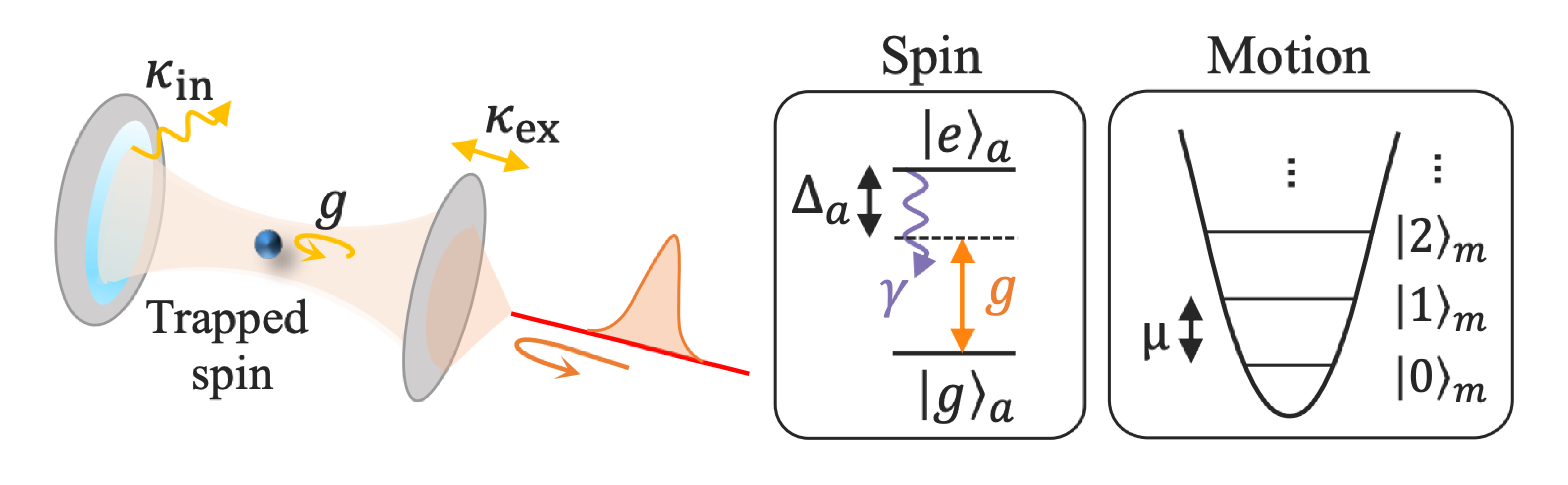
In distributed quantum computing, remote Bell pairs provide essential connectivity between the modules, and the quality of the atom-photon interface directly determines system performance and overhead, such as error correction (entanglement distillation) overhead, computing speed, and achievable fidelity. CAPS provides not only high-rate and fidelity but a robust means to realizing such interfaces, featuring high tolerance to photon impurity, robustness to experimental imperfections, and notably, without the need for inter-module synchronization [2]. Our system-level analysis has shown that this passive quantum interconnect approach can achieve both high rate and high fidelity, exceeding fidelity of 0.999 with near-term cavity parameters. Combined with multiplexing, the entanglement generation rate can be pushed beyond 1 MHz just with a single cavity [2].
Concurrently, atomic motion has emerged as a fundamental limit on entanglement fidelity. Photon recoil induces unwanted spin-motion-photon entanglement, degrading gate performance. While this effect has been actively studied in emission-based interconnects, its impact on CAPS remained poorly understood: conventional theories for CAPS typically neglect atomic motion, while a few existing works are limited to the dispersive-coupling regime [8], excluding the resonant conditions required for heralded CAPS gates. As a result, the motion-induced performance limit of CAPS has remained an important open question.
Our Solution
We extend scattering theory to an operator-valued formalism, explicitly including atomic motion. This compact operator-valued input-output relation remains analytically tractable even in the resonant regime relevant to high-fidelity CAPS gates. This formulation is highly general, capturing standing-wave and running-wave cavities, state-dependent trapping potentials, and multiple non-identical atoms coupled to a single cavity mode within a unified framework. This provides not only an intuitive picture of how photon reflection perturbs the motional state of a trapped atom, but also a detailed evaluation of motion effects on CAPS gates, revealing the key design guidelines.
Key Results
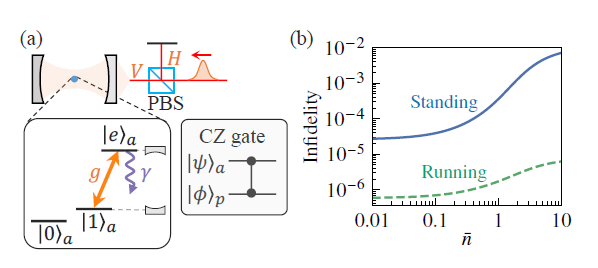
- CAPS gates are intrinsically robust to motion-induced errors: Unlike emission-based protocols [3], whose infidelity increases as atom-cavity coupling exceeds cavity decay, the CAPS gate infidelity remains nearly constant across both strong-coupling and bad-cavity regimes, provided the output coupling is optimized.
- Recoil-induced errors stay below 0.1%: With appropriately chosen output coupling, recoil-induced errors remain below the 0.1% level even at finite temperature – without requiring ground-state cooling – and are further suppressed in the resolved-sideband regime.
- Trap mismatch imposes a simple design rule: When the trap frequency μe of the excited state is larger than that of the ground state μ, infidelity scales as (μe/μ)4. In contrast, the shallower trapping potential for the excited state (μe < μ) suppresses infidelity comparable to magic trapping (μe = μ), which is typically aimed for in trapped-atom experiments. This indicates that suppressing motion-induced error does not require exact magic trapping; in practice, low error can be maintained as long as the excited-state trap frequency remains below that of the ground state.
Outlook
This work identifies CAPS as an intrinsically motion-robust protocol for high-rate, high-fidelity remote entanglement generation under realistic conditions of trapped atoms, making it an ideal building block for scalable distributed quantum computing [9, 10] and quantum network applications such as [7]. At the system level, this robustness directly strengthens our roadmap toward QPU-compatible high-rate, high-fidelity quantum networking, translating directly into actionable hardware design principles.
Beyond formalizing error mechanisms, this work opens a new opportunity, treating atomic motion not only as a source of decoherence but as a controllable quantum resource.
The same spin-motion-photon coupling could be deliberately harnessed for hybrid protocols involving coherent control of all internal, motion, and photonic degrees of freedom, and also extends to many-body motion-photon dynamics in multi-atom cavity systems, which will be of independent interest.
This work demonstrates our active co-design loop between experiment and theory in cavity quantum electrodynamics – working together with FTQC and application theorists – a comprehensive approach central to pushing the boundaries of quantum networking.
References
[1] S. Kikura, A. Senoo, A. Goban, and S. Sunami, “Scattering theory for cavity-assisted spin-motion-photon interactions” (2026). arXiv:2606.26542.
[2] S. Kikura et al., arXiv:2507.01229, [NanoQT Blog]
[3] S. Kikura et al., PRX Quantum 6, 040351 (2025). [NanoQT Blog]
[4] S. Saha et al., Nature Communications 16, 2533 (2025).
[5] J. Apolín and D. P. Nadlinger, PRX Quantum 7, 010326 (2026).
[6] Y. Yu et al., Phys. Rev. A 113, 012620 (2026).
[7] C. Li, S. Kikura, et al., arXiv:2604.07451 [NanoQT Blog].
[8] L. Neumeier, T. E. Northup, and D. E. Chang, Phys. Rev. A 97, 063857 (2018).
[9] S. Sunami et al., PRX Quantum 6, 010101 (2025). [NanoQT Blog]
[10] S. Sunami et al. PRX Quantum (2026), arXiv:2511.10729 [NanoQT Blog].